Adding a teen driver to car insurance usually means calling your insurer when your teen gets a learner’s permit, asking whether they must be listed yet, and listing them no later than the day they are licensed. Most families add the teen to the parents’ policy. Expect your premium to rise, then use discounts, the right car and the right limits to keep it reasonable.
This guide walks through how graduated driver licensing works, when insurers want to know about a permit driver, the discounts that often apply to young drivers, and whether a separate policy ever makes sense. The safety numbers here come only from official and research sources, and each one has a date next to it.
We are an independent publication, not an insurer or agent. Rules differ by state and by insurer, so treat this as a map and confirm the details with your own insurer and your state.
Why does adding a teen driver raise car insurance costs?
Insurers price policies by risk, and new teen drivers crash more often than experienced drivers. When a teen joins your policy, the insurer expects more claims, so the premium usually goes up.
The research backs this up. According to the Insurance Institute for Highway Safety (IIHS), the fatal crash rate per mile driven for 16- to 19-year-olds was about three times the rate for drivers 20 and older, based on 2022 travel data in its Fatality Facts posted in June 2026. IIHS also says crash risk is highest at ages 16 and 17.
The National Highway Traffic Safety Administration (NHTSA) reports that in 2024 young drivers (ages 15 to 20) were 9 percent of all drivers involved in fatal crashes but only 5.2 percent of licensed drivers (NHTSA, Traffic Safety Facts: Young Drivers, July 2026). And IIHS counted 2,899 teenagers ages 13 to 19 who died in motor vehicle crashes in 2024, which it notes is far fewer than in 1975.
These numbers explain the price change. They do not mean your teen will crash. Practice, rules at home and a safe car all lower the real risk. For more on what moves premiums, see how car insurance rates are calculated.
What is graduated driver licensing (GDL)?
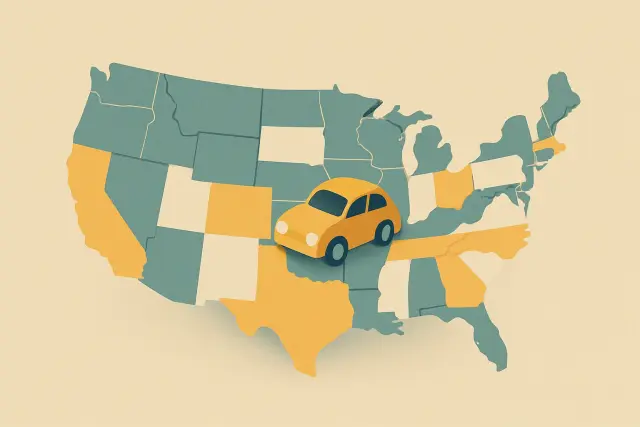
Graduated driver licensing (GDL) gives new drivers privileges in stages, so they gain experience in lower-risk settings first. States set their own GDL rules, so the ages, hours and limits differ from place to place.
The three stages
| Stage | What it usually involves | What to check in your state |
|---|---|---|
| 1. Learner’s permit | Driving only with a licensed adult in the car; a minimum number of practice hours | Minimum age, how long the permit must be held, required practice hours |
| 2. Intermediate license | Driving alone, with limits on night driving and teen passengers | Night curfew hours, passenger limits, phone rules, how long limits last |
| 3. Full license | Limits end | The age or time that ends the intermediate stage |
IIHS describes the intermediate stage as limiting driving “in high-risk situations,” such as at night or with teen passengers, and says GDL evaluations show these systems reduce crashes substantially (IIHS, 2026). IIHS also notes that 35 percent of teen driving deaths in 2024 happened between 9 p.m. and 3 a.m.
The CDC cites a 2015 NHTSA review of 14 studies that linked GDL with about 19 percent fewer injury crashes and about 21 percent fewer fatal crashes for 16-year-olds (CDC, Preventing Teen Crashes, 2025).
GDL rules are set by your state DMV or licensing agency, not by your insurer. Your insurer will still care if your teen breaks them, because a ticket or crash can affect the price at renewal.
When should you add a permit driver to your policy?
Call your insurer as soon as your teen gets a learner’s permit. Whether the permit driver must be formally listed depends on your insurer and, in some cases, your state.
There is no single national rule. Here is how it commonly works:
- Some insurers extend your existing coverage to a permit driver who lives with you and drives only with a licensed adult, and do not charge until the teen is licensed.
- Other insurers want the permit driver listed right away, sometimes with no change in price until licensing, sometimes with one.
- Almost all insurers expect you to list a teen once they are licensed. Policies generally ask you to report every licensed driver in your household.
Questions to ask your insurer
- Is a permit driver in my household covered when supervised? Do I need to list them now?
- Will my price change at the permit stage, or only at licensing?
- On what date must I add my teen after they are licensed?
- Which car will you rate my teen on, and can I assign them to a specific car?
- Which discounts can my teen qualify for, and what proof do you need?
Write down the answers, the name of the person you spoke with and the date. Ask for any important answer by email.
Should you add your teen or buy a separate policy?
For most families, adding a teen to the parents’ policy is simpler and cheaper. A separate policy can make sense in a few specific situations.
| Factor | Add teen to your policy | Separate policy for the teen |
|---|---|---|
| Usual price | Often lower overall, because household discounts (multi-car, bundling) can still apply | Often higher, because the teen is rated alone |
| Car ownership | Works when parents own the cars | Usually needed if the teen owns and titles the car |
| Liability limits | Teen shares your (often higher) limits | Teen may choose lower limits, which gives less protection |
| Claims history | A teen’s crash can affect your policy’s price | Keeps a teen’s claims on their own record |
| Paperwork | One policy, one bill | Two policies to manage |
If someone else in your household is the car’s owner, the insurer usually expects the car to be insured where it is garaged and titled. Ask how they handle it before you sign.
Which discounts can lower the cost of a teen driver?
Ask about student, training and usage discounts. Each insurer sets its own rules and amounts, so get the details in writing.
The Insurance Information Institute (III) says a young driver may qualify for a lower rate if they are a good student, have taken a driver’s education course, or are away at college without a car (III, 2026). Common discount types include:
- Good student. Usually needs a grade point average, honor roll or class rank above a set level, plus proof each term or year.
- Driver education or training. Completing an approved course. Ask which courses count before you enroll.
- Student away at school. For a student living far from home without a car.
- Telematics or usage-based programs. An app or device tracks driving habits such as hard braking and phone use. Results can raise or lower the price, so read the terms.
- Multi-car and bundling. Insuring more cars or your home or renters policy with the same insurer.
See our car and home insurance discounts guide for a full checklist.
Which car should your teen drive?
The safest car for a new driver is one with strong crash protection and modern safety features. The car also affects your premium.
IIHS advises that young drivers stay away from high-horsepower models, which can encourage speeding, and says electronic stability control (ESC) is a must. IIHS also recommends choosing vehicles with the best crash-test ratings possible and publishes a list of recommended new and used vehicles for teens (IIHS, 2026).
On insurance cost, these points usually matter:
- Repair costs and theft rates affect collision and comprehensive premiums.
- An older car might not need collision coverage if its value is low. Compare the premium with what the car is worth.
- Assigning the teen to a car may change the price, if your insurer allows it.
Read our guide to car insurance coverage types if any of these terms are new.
How much liability coverage do you need with a teen driver?
Review your limits when a teen joins your policy. State minimums are a legal floor, and they may not cover a serious crash.
If damages go above your limits, the people you hurt can seek the rest from you. Families with savings or a home often choose limits well above the minimum. Check your state’s floor in our state minimum car insurance guide, then ask for quotes at two or three higher levels so you can see the difference in price.
An umbrella policy adds extra liability coverage on top of your auto and home policies. It is worth asking about if you have significant assets.
How do you keep the cost and the risk down?
Lower risk and lower price often go together. A safe start helps your teen and, over time, your premium.
- Practice more than the minimum. Cover night, rain, highways and busy parking lots with an adult in the car.
- Agree on rules in writing. Phones away, seat belts always, and limits on passengers and night driving.
- Model good habits. Teens copy what they see from the driver’s seat.
- Keep the record clean. Tickets and at-fault crashes can raise the price at renewal.
- Re-shop at key moments. When your teen gets a full license, turns a new age bracket, or goes to college, compare quotes again using our guide to comparing insurance quotes.
Where can you get help?
Your state insurance department can answer questions about your rights as a policyholder and take complaints. You can find yours through the NAIC’s directory of state insurance departments. For licensing rules, permit ages and GDL limits, go to your state DMV or driver licensing agency.
This article is educational. It is not insurance, legal or financial advice. Your policy documents and your insurer are the final word on what is covered.