The main difference between no-fault vs at-fault states is who pays for injuries first after a car crash. In a no-fault state, your own personal injury protection (PIP) pays your medical bills and some other costs, no matter who caused the crash, and your right to sue is limited. In an at-fault state, the driver who caused the crash, through their liability insurance, pays for the other people’s injuries.
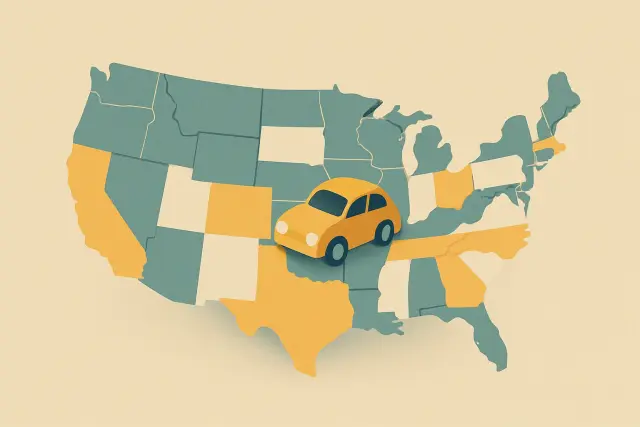
Twelve states have no-fault auto laws as of October 2026: Florida, Hawaii, Kansas, Kentucky, Massachusetts, Michigan, Minnesota, New Jersey, New York, North Dakota, Pennsylvania and Utah (Insurance Information Institute, accessed October 2026). Puerto Rico also has a no-fault law. The rest of the states, and Washington, DC with its own choice system, mainly use the fault system.
This guide explains how each system works, lists the no-fault states and their lawsuit thresholds, and covers what changes for you after a crash. It is general education, not legal advice. For a specific claim, talk with your insurer or a lawyer licensed in your state.
What is a no-fault state?
A no-fault state requires drivers to carry PIP, which pays your own injury costs after a crash regardless of fault. In exchange, the state limits lawsuits for pain and suffering unless an injury is serious enough.
The idea is to get injured people paid quickly without waiting for a fault decision or a lawsuit. Minor injury claims are handled by each person’s own insurer.
What is an at-fault state?
In an at-fault state, also called a tort state, the driver who causes a crash is responsible for the other people’s injuries and damage. That driver’s bodily injury and property damage liability insurance pays, up to its limits.
If you are hurt by another driver in an at-fault state, you usually file a claim with that driver’s insurer or sue them. You can also use your own coverage, such as medical payments, collision or uninsured motorist coverage, and your insurer may then seek repayment from the at-fault driver’s insurer.
No-fault vs at-fault: side-by-side comparison
| Question | No-fault state | At-fault state |
|---|---|---|
| Who pays your injury costs first? | Your own PIP | The at-fault driver’s liability insurance (or your own optional coverage) |
| Is PIP required? | Yes | Usually not, with a few exceptions |
| Can you sue for pain and suffering? | Only if your injury meets a threshold | Yes, if the other driver was at fault |
| Who pays for vehicle damage? | Based on fault (except Michigan’s in-state rules) | Based on fault |
| Does fault still matter? | Yes, for vehicle damage, serious injuries and rates | Yes, for everything |
Which states are no-fault states?
The Insurance Information Institute lists 12 states and Puerto Rico with no-fault auto insurance laws, and three of them as choice no-fault states (III, accessed October 2026). The table below shows each state’s minimum PIP and its lawsuit threshold, as of October 2026.
| State | Minimum PIP (as of 2026) | Threshold type | When you can sue for pain and suffering (summary) |
|---|---|---|---|
| Florida | $10,000 | Verbal | Significant and permanent injury, scarring or disfigurement, or death |
| Hawaii | $10,000 | Monetary and verbal | PIP benefits used up, or serious injury such as death or permanent loss of use or disfigurement |
| Kansas | $4,500 medical, plus other benefits | Monetary | Medical treatment of $2,000 or more, or certain serious injuries such as some fractures or permanent injury |
| Kentucky (choice) | $10,000 | Monetary | Medical expenses over $1,000, or certain serious injuries; you can reject the limits in writing |
| Massachusetts | $8,000 | Monetary | Medical expenses over $2,000, or certain serious injuries such as fractures or permanent disfigurement |
| Michigan | You choose a PIP medical level | Verbal | Death, serious impairment of body function, or permanent serious disfigurement |
| Minnesota | $40,000 ($20,000 medical, $20,000 non-medical) | Monetary and verbal | Medical expenses over $4,000, or permanent injury, disfigurement, death, or disability of 60 days or more |
| New Jersey (choice) | $15,000 | Verbal (if you choose it) | Under the limitation on lawsuit option, only listed permanent injuries |
| New York | $50,000 | Verbal | “Serious injury” as defined by state law |
| North Dakota | $30,000 | Monetary and verbal | Medical expenses over $2,500, or death, dismemberment, serious permanent disfigurement, or disability beyond 60 days |
| Pennsylvania (choice) | $5,000 medical | Verbal (if you choose it) | Under limited tort, only a “serious injury” |
| Utah | $3,000 | Monetary and verbal | Medical expenses over $3,000, or death, dismemberment, permanent disability or impairment, permanent disfigurement, or a bone fracture |
Sources for the thresholds include each state’s statutes and insurance regulators, such as Minnesota Statutes 65B.51, Utah Code 31A-22-309 (amended May 6, 2026), North Dakota Century Code 26.1-41 and K.S.A. 40-3117. The table is a simplified summary; the exact legal wording in your state controls.
What is a tort threshold?
A tort threshold is the line your injury must cross before you can sue the at-fault driver for pain and suffering in a no-fault state. There are two kinds.
Monetary thresholds
A monetary threshold is a dollar amount of medical expenses. Once your reasonable medical costs pass it, you can sue. For example, Minnesota’s threshold is medical expenses over $4,000 (Minnesota Statutes 65B.51), and Utah’s is over $3,000 (Utah Code 31A-22-309, amended May 6, 2026). Most monetary-threshold states also let you sue for certain serious injuries regardless of cost.
Verbal thresholds
A verbal threshold describes the injury in words instead of dollars, such as “serious injury,” “permanent injury” or “serious impairment of body function.” New York, Florida and Michigan use verbal thresholds. In New Jersey and Pennsylvania, the verbal threshold applies only if you choose the limited lawsuit option.
How do choice no-fault states work?
In a choice no-fault state, you decide whether to accept limits on your right to sue. Giving up some lawsuit rights usually lowers your premium.
- New Jersey. You choose the limitation on lawsuit option (you can sue for pain and suffering only for listed permanent injuries) or the no limitation on lawsuit option. The New Jersey Department of Banking and Insurance explains these choices in its 2026 buyer’s guide.
- Pennsylvania. You choose limited tort (you can sue for pain and suffering only for a serious injury) or full tort (no such limit).
- Kentucky. Drivers are covered by the no-fault system unless they reject its tort limits in writing. Rejecting it can affect your own PIP benefits, so read the form carefully before you sign.
Washington, DC uses its own system. The III notes that DC is neither a true no-fault nor an add-on state; it lets drivers choose between no-fault benefits and the fault-based system (III, accessed October 2026).
Do any at-fault states require PIP?
Yes. A few states require PIP but do not limit your right to sue. These are sometimes called add-on states, because PIP is added on top of the fault system.
- Delaware requires PIP of $15,000 per person and $30,000 per accident.
- Maryland requires $2,500 of PIP, which you can waive.
- Oregon requires $15,000 of PIP.
Other states require insurers to offer PIP or medical payments coverage, which you can usually turn down in writing. Texas and Arkansas are examples. Our state minimum car insurance table lists each state’s required coverages.
What happens after a crash in a no-fault state?
The claim process for injuries starts with your own insurer, even if the other driver caused the crash.
- Get medical care and report the crash. Follow your state’s reporting rules and get treatment promptly.
- Notify your insurer quickly. Many no-fault states have short deadlines to apply for PIP benefits, so read your policy and call early.
- File your PIP claim. Your PIP pays covered medical bills and other benefits up to its limit.
- Handle the car separately. Claim against the at-fault driver’s property damage liability, or use your own collision coverage.
- Check the threshold. If your injuries are serious or your costs are high, ask whether you meet your state’s threshold to sue.
Does no-fault insurance cost more?
It depends on the state, and simple comparisons can be misleading. PIP adds a required coverage, but limits on lawsuits are meant to reduce some claim costs. Many other factors, such as medical costs, fraud levels, repair costs and your own profile, also shape your price. We explain these in how car insurance rates are calculated.
In Florida, which requires $10,000 of PIP and $10,000 of property damage liability, lawmakers have debated replacing PIP for years. As of October 2026, PIP is still required. Our guide to Florida car insurance requirements covers the details.
How do you choose coverage in a no-fault state?
PIP covers only the minimum required amount unless you choose more. A few steps can help:
- Check your PIP limit. Some states let you buy higher limits or choose different benefit levels, as in Michigan and New Jersey.
- Think about health insurance coordination. In some states you can coordinate PIP with your health plan, which can affect both price and how bills are paid.
- Keep strong liability limits. If you cause a crash with serious injuries, the other person may meet the threshold and sue you.
- Consider UM/UIM. It helps when an at-fault driver with no or low insurance seriously injures you.
- Compare the same coverage. Our guide to car insurance coverage types explains each coverage so you can compare quotes fairly.
The bottom line
No-fault and at-fault systems differ mainly in who pays for injuries first and when you can sue. Twelve states use no-fault, three of them with a choice, and a few at-fault states still require PIP. Vehicle damage follows fault almost everywhere. Learn your state’s PIP minimum and lawsuit threshold before you buy, and choose your lawsuit option and limits on purpose rather than by default.